
Let's talk about your production
One platform, set up for your factory
We listen to how you produce and decide together which modules you need. Installation is done on site and training is included.
June 24, 2026
In classic ERP thinking the routing belongs to the part: operations and times are written on the item master and copied when a work order is opened. For series production this is correct, because the same part runs on the same line in the same sequence every time.
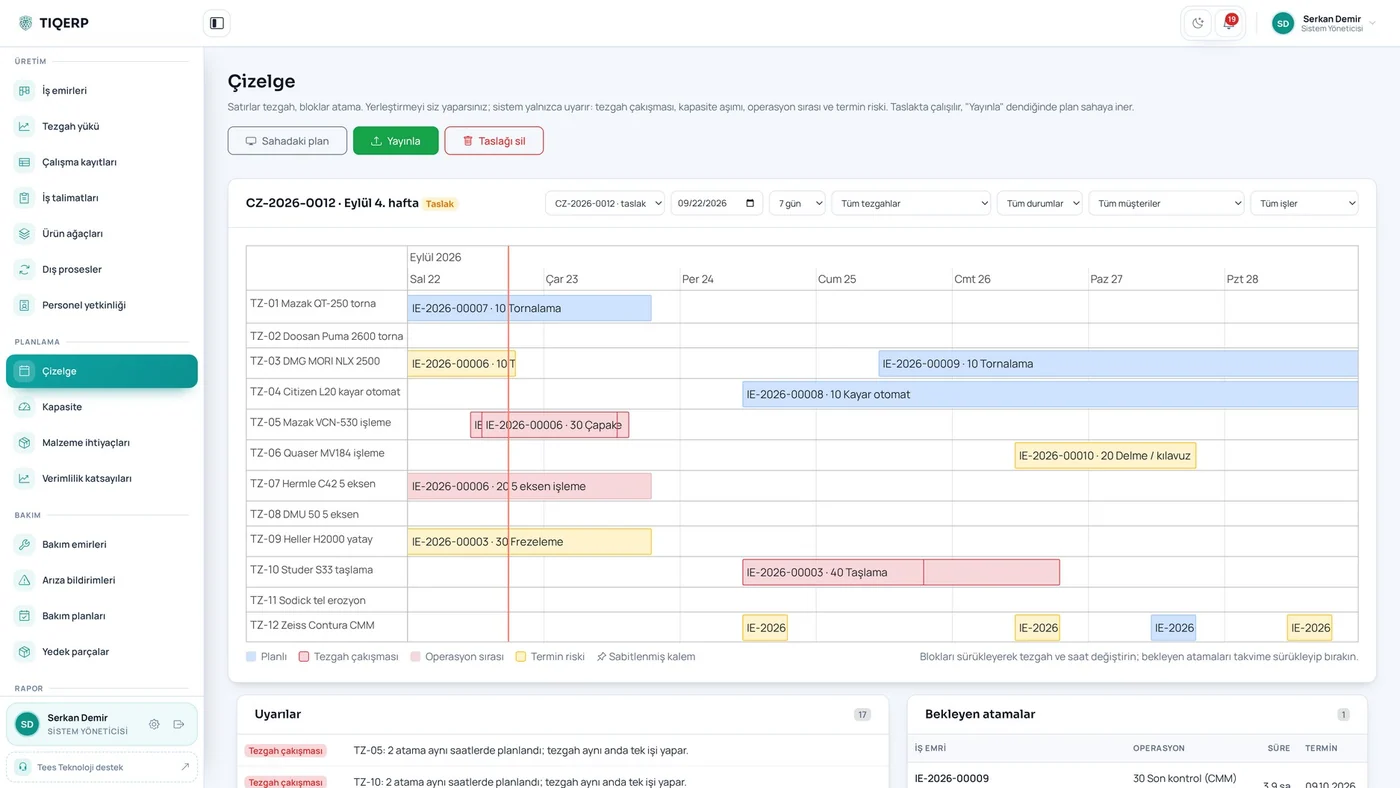
Job shops work differently. If the five-axis machines are busy, the job moves to three-axis; grinding is outsourced; when a customer is in a hurry an operation is split across two machines. The same flange may run on TZ-01 this month and TZ-03 next month. If the routing is fixed to the part, this flexibility either cannot be recorded or forces you to edit the item master every time, which destroys the meaning of your history.
TIQERP manages production in three layers, and the routing belongs to the middle one, the work order:
For repeat parts nothing has to be typed twice: the routing is copied from the previous work order and adjusted if needed. Speed is kept and each work order still carries its own reality.
Because assignment is its own layer, an operation can be divided across machines or operators, which in practice means an idle machine can be brought in. One operator can also run two machines at once; machine cost is calculated from raw duration and labour from shared duration, so labour is never counted twice.
Heat treatment, coating and grinding enter the routing as a line. Material issue, delivery to the supplier and return inspection are tracked on the same work order, so a part is never invisible while it is outside. Keeping outsourced steps in a separate ledger is the classic reason for discovering on shipping day that the parts are still at the coater.
When the routing belongs to the work order, the drawing revision is fixed to it as well. If the customer issues a new revision, open work orders are flagged and you see on one screen which ones are running on the old revision. This is among the errors shops in the aerospace supply chain fear most.
In short: tying the routing to the part is the answer for series production. The answer for a job shop is that the routing belongs to the job.
We listen to how you produce and decide together which modules you need. Installation is done on site and training is included.