
Let's talk about your production
One platform, set up for your factory
We listen to how you produce and decide together which modules you need. Installation is done on site and training is included.
Three categories meet you when looking for production software. Here is what each one solves and what it does not.

Three categories meet you when looking for production software. Here is what each one solves and what it does not.
What each category solves and what it does not
The table below compares categories rather than products. Any given product may not carry the typical scope of its category, so we suggest asking each candidate about these rows one by one during your evaluation.
| Topic | Classic ERP | Pure MES | TIQERP |
|---|---|---|---|
| Quotation and order | Yes | No | Yes |
| Stock, warehouse and lot tracking | Yes | Limited | Yes |
| Purchasing and supplier approval | Yes | No | Yes |
| Scheduling and capacity | Limited | Yes | Yes |
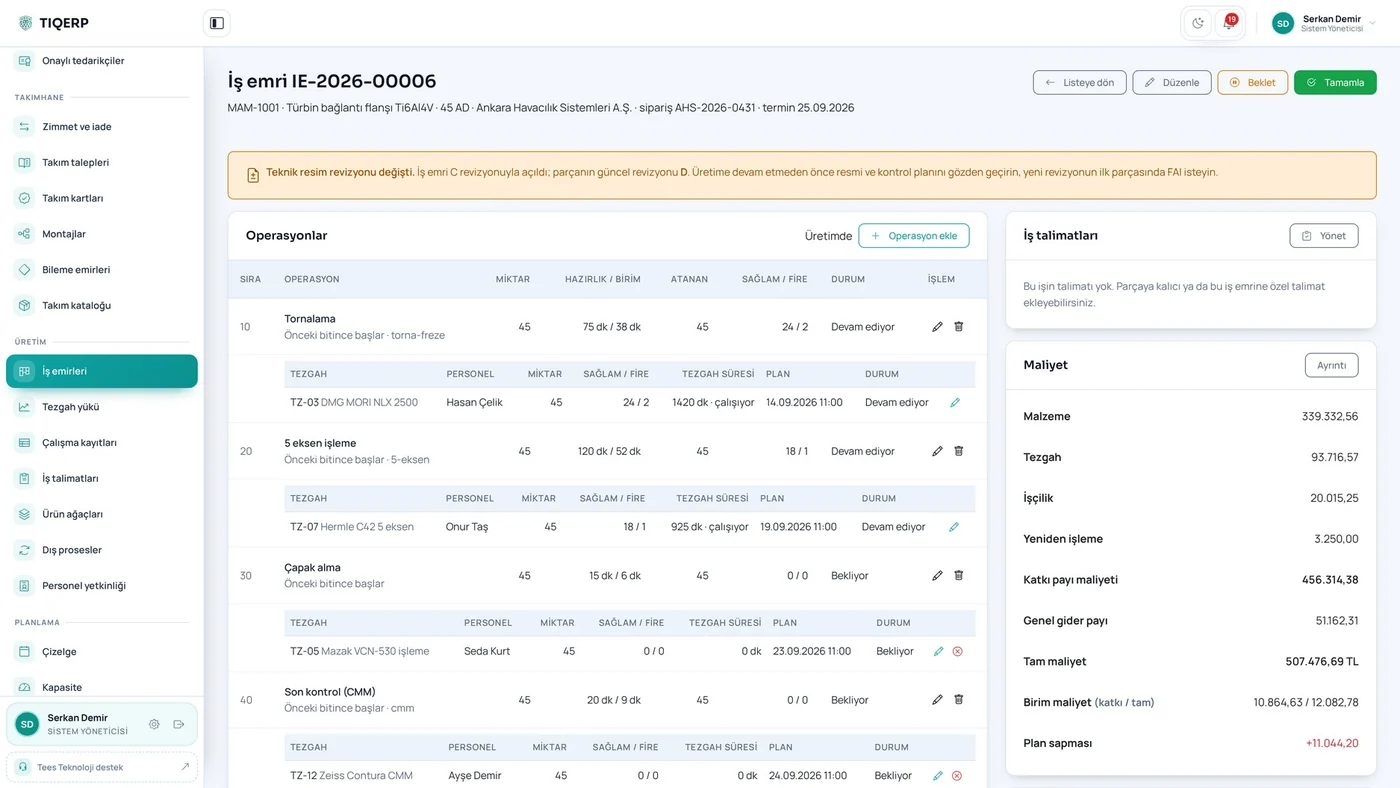
| Routing owned by the work order | No | Varies | Yes |
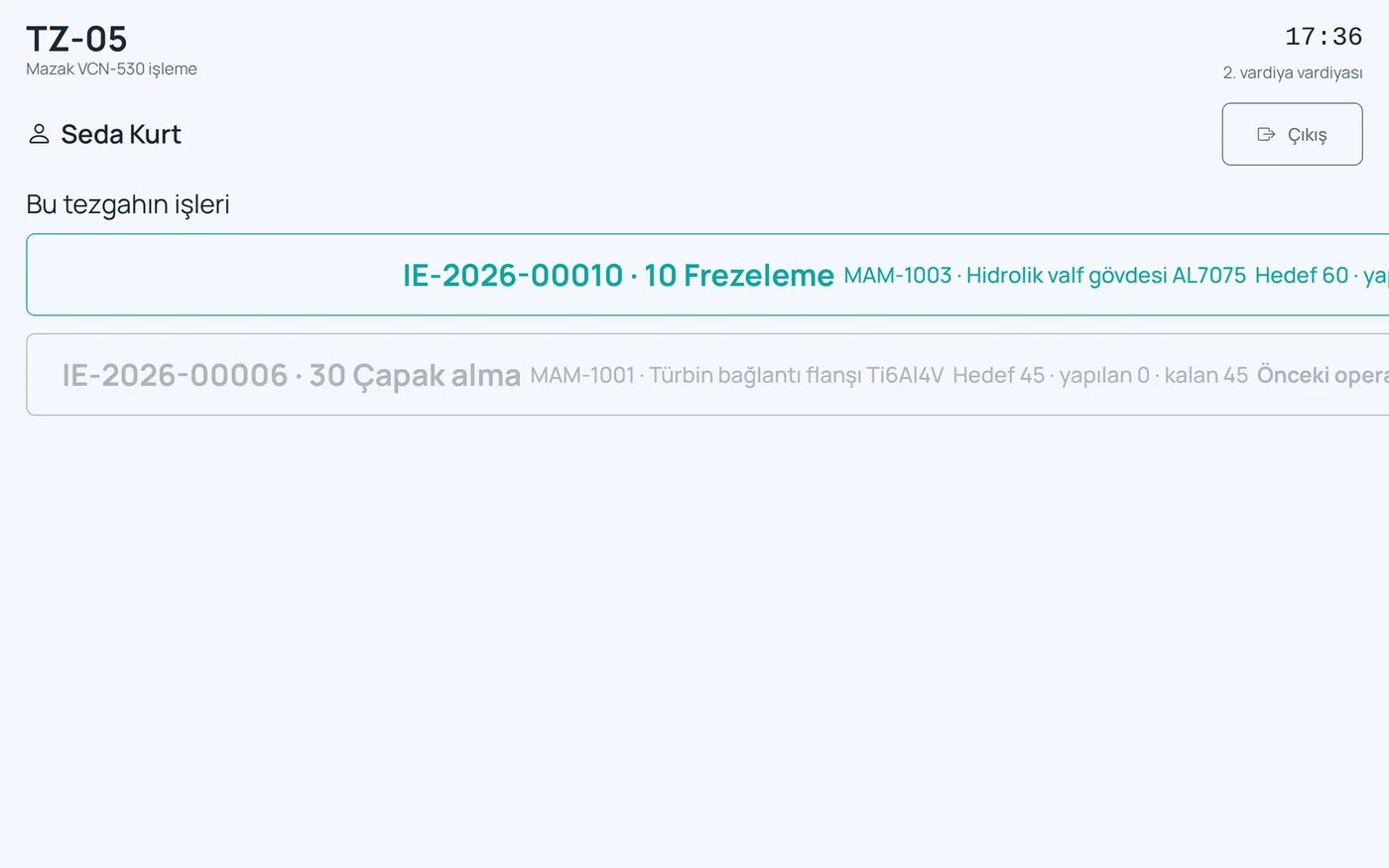
| Shop floor terminal and downtime capture | No | Yes | Yes |
| Work instruction approval and versioning | No | Varies | Yes |
| Control plan and inspection records | Limited | Varies | Yes |
| First article (AS9102), SPC, 8D | No | Rarely | Yes |
| Measuring equipment and calibration | No | Rarely | Yes |
| Tool crib and regrinding | No | Rarely | Yes |
| Maintenance and breakdowns | Varies | Varies | Yes |
| Actual work order cost | Estimated | Partial | Yes |
| Lot and serial traceability | Limited | Partial | Yes |
| Machine connectivity and OEE | No | Yes | Yes |
| On-premises and closed network | Varies | Usually cloud | Yes |
| Licence structure | Per user | Subscription | Setup fee + mandatory annual |
| Extra fee per user | Usually | Usually | None |
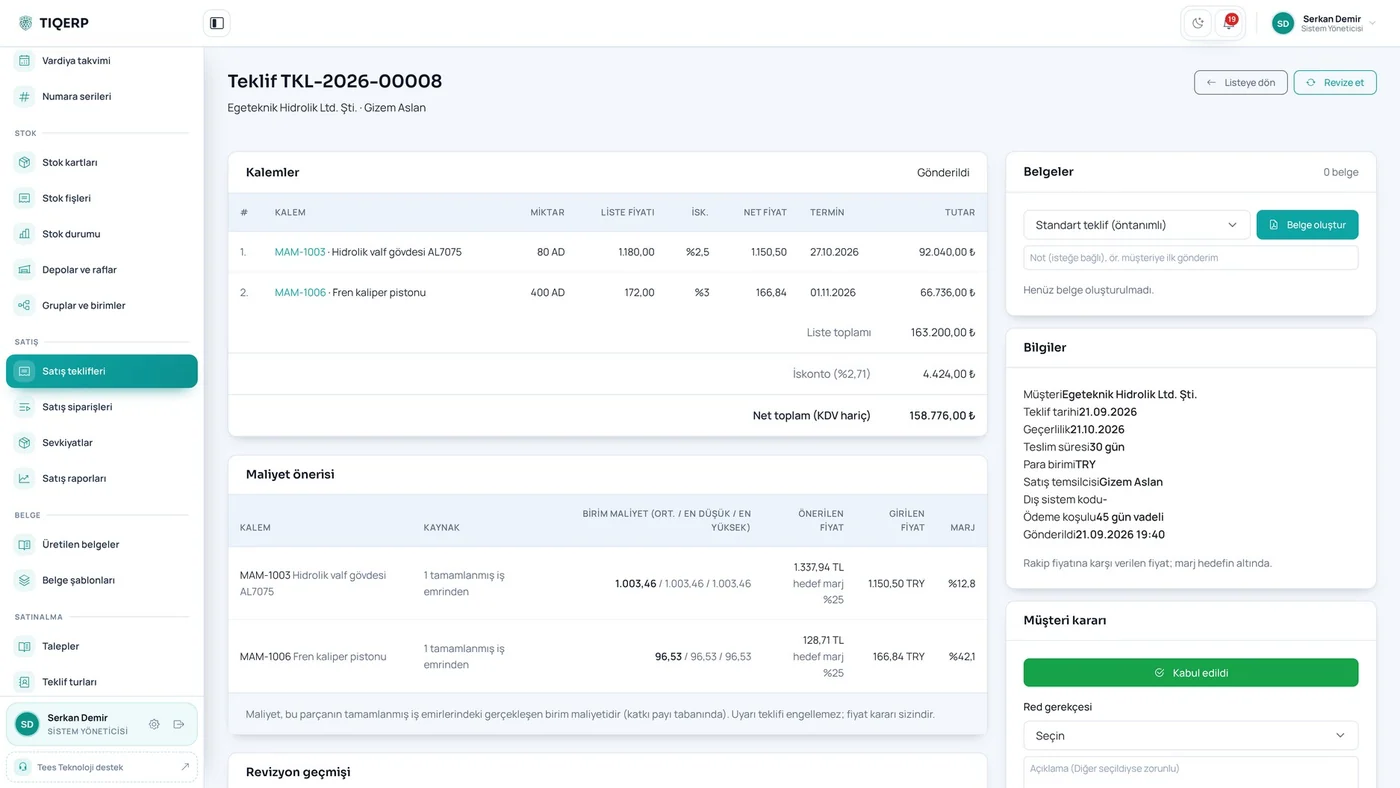
The common answer is an ERP for the commercial side and an MES for the floor, connected to each other. That arrangement creates three cost items: the integration itself, the work of keeping the same bill of materials current in two places, and two separate support lines. TIQERP's answer is to put both on a single database — no transfers, no mapping, no overnight jobs.
To be straight about it: it does not issue invoices and does not keep ledgers; those stay in your accounting software, and only the invoice number is marked in TIQERP.
We listen to how you produce and decide together which modules you need. Installation is done on site and training is included.