
Let's talk about your production
One platform, set up for your factory
We listen to how you produce and decide together which modules you need. Installation is done on site and training is included.
August 5, 2026
In shops that hold AS9100D or are preparing for it, the procedures are usually written. The audit stalls somewhere else: when the record proving a procedure was followed is requested, it either does not exist or has to be assembled from three different folders. Here are the topics that cause the most trouble and where the record has to be created.
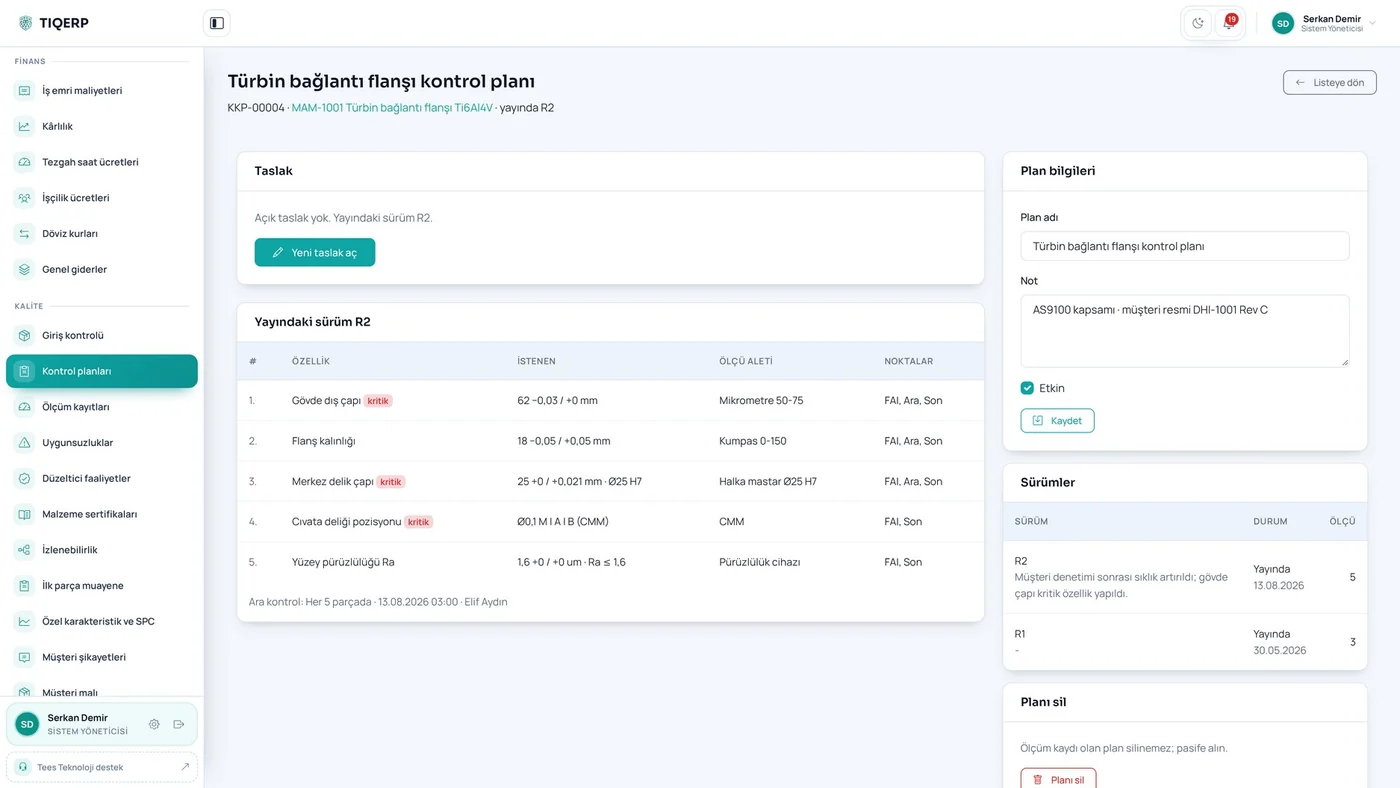
An AS9102 record shows that design characteristics were verified one by one. Filled in afterwards it is almost always incomplete: which gauge produced which measurement, and against which revision the part was checked. If that is not entered at the moment of measurement, it is not remembered later.
The auditor's question is simple: which revision was this part built to? The answer has to live on the work order. If the revision is not fixed to it, you cannot show which jobs a mid-production revision change affected.
Competence records are required for special processes such as welding, heat treatment and NDT. If those records sit in a training file but nothing on the production side checks them, the auditor asks whether an unqualified person could have run the operation. Defining authorisation per operation and blocking unauthorised work at the terminal closes that question.
Most shops have a calibration plan. What is missing is the ability to list affected jobs when a device is found out of tolerance, which depends on recording the device used for each measurement.
The approved supplier list, tracking of parts sent out and inspection on return are asked for together. If outsourced steps live in a separate ledger, the traceability chain breaks for the whole time the parts are away.
Not being able to ship without quality approval should be a behaviour of the system, not a clause in a procedure. Keeping shipping closed while an inspection is missing or a nonconformity is open can be demonstrated on a single screen.
You need to move from a lot or serial number to the work order, the operator, the lot number of the material used and the supplier certificate behind it. If every link sits in a different system, that journey takes days rather than minutes.
The common thread: none of these records can be produced retrospectively. They either emerge as a by-product of daily work or they are missing when the auditor asks. Software cannot make anyone certified; its job is to hold the record at the moment work is done, with the right links attached.
We listen to how you produce and decide together which modules you need. Installation is done on site and training is included.