
Let's talk about your production
One platform, set up for your factory
We listen to how you produce and decide together which modules you need. Installation is done on site and training is included.
July 15, 2026
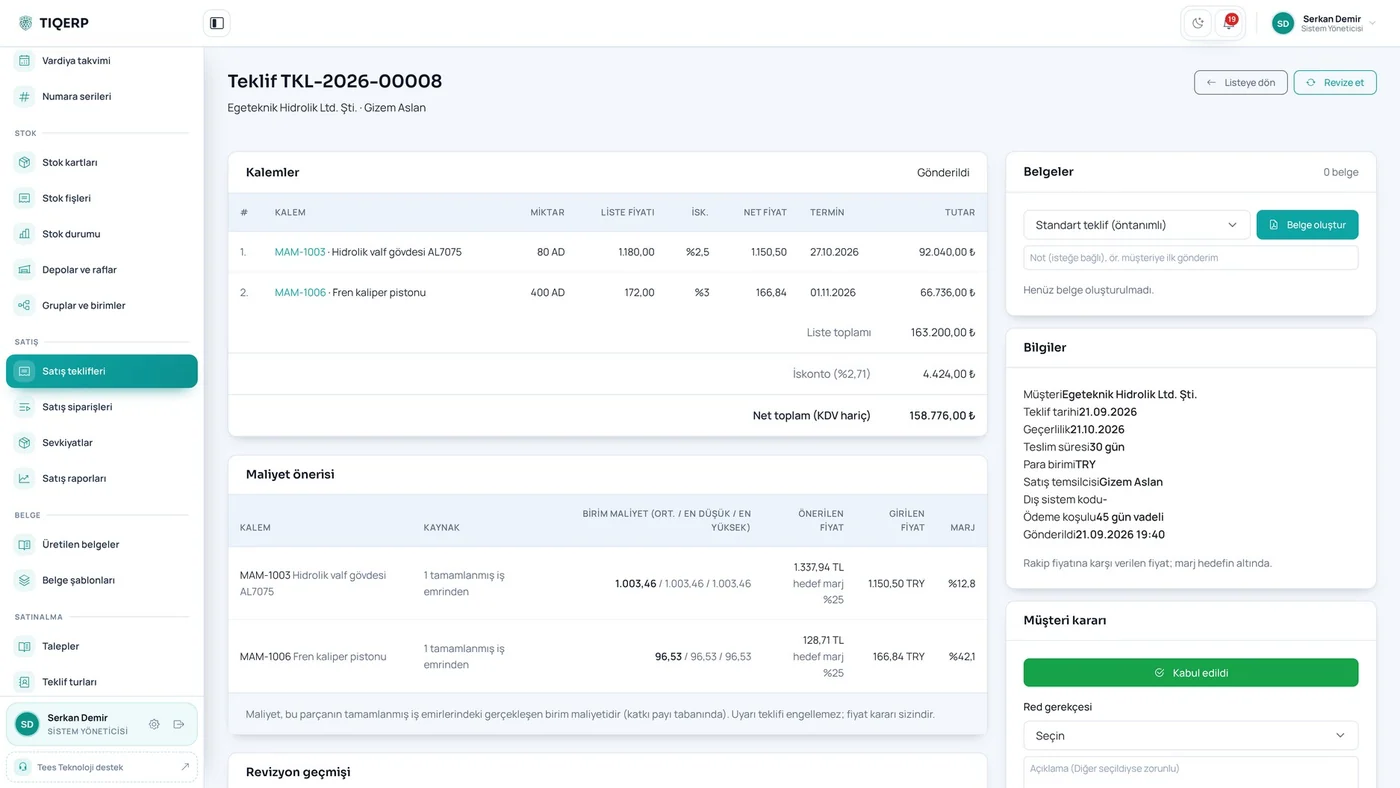
Pricing in a machine shop usually works like this: you recall a similar job, add something to it, then shave a little because of competition. In experienced hands this works surprisingly well. The problem is that the method never corrects itself: when a badly priced job is finished, that knowledge does not travel back to the person who priced it.
The actual cost of a work order comes from the weighted average cost of material issued to it, actual machine time multiplied by the machine hourly rate, operator time multiplied by the labour rate, outsourced process costs, scrapped material and any rework after a nonconformity.
The last two belong in their own lines. If scrap and rework disappear into the total, you cannot see where the loss came from, and that is the instructive part. A part that consistently scraps 8% has a process problem, not a pricing problem.
When one operator runs two machines, machine cost is calculated from raw duration, because the machine really was busy that long, while labour is calculated from shared duration, because the person is paid once. Without that distinction labour comes out double and the whole cost picture is systematically wrong. In shops where operators run several machines, this single distinction decides how accurate costing is.
In most shops the machine hourly rate was either never calculated or calculated once years ago. The arithmetic is simple: add depreciation, energy, maintenance, rent share and other fixed costs, then divide by the planned annual running hours. If maintenance costs are already in the system, they feed the calculation on their own. Keep an effective date on the rate so that old work orders stay at the old rate and history remains comparable.
The critical step: the actual cost of a completed work order should appear on the screen of whoever prices the next quotation for that part. When planned and actual cost sit side by side, the difference tells you which assumption failed — duration, scrap or outsourcing.
Once the loop is closed, a quoted price stops being a guess and becomes a consequence of your own production history. Three months later you can see, without arguing, which jobs make money and which do not.
We listen to how you produce and decide together which modules you need. Installation is done on site and training is included.